How Plexus Helped Design a Sponsorship Bidding Platform for a UK Equestrian Sports Club
Big sponsors have always had an easy path into sports events. The small ones don't. A UK based equestrian sports club saw that gap clearly - and reached out to Plexus Technolabs to help build a platform that would change it.
What Was the Problem This Club Was Trying to Solve?
Equestrian sports events – from polo matches to competitive riding tournaments attract sponsors at every level. But the reality is that large, established brands dominate. Smaller businesses that genuinely want to support a local team, sponsor a jersey, or brand a set of equipment rarely get a fair shot. There is no structured, transparent process that gives them one.
The UK sponsorship market is a significant one. Sponsorship management remains a $100 billion global industry, yet most sports clubs – especially at the club and regional event level – still handle sponsor outreach manually, through spreadsheets and direct contacts. (SponsorCX) For smaller sponsors, that means no clear entry point and no visibility into what’s actually available.
This club wanted to fix exactly that – a digital platform where every upcoming event is listed, every sponsorship opportunity is visible, and any interested sponsor can place a bid. Highest bid wins the slot. Simple, transparent, and open to businesses of any size.
What Did Plexus Actually Do?
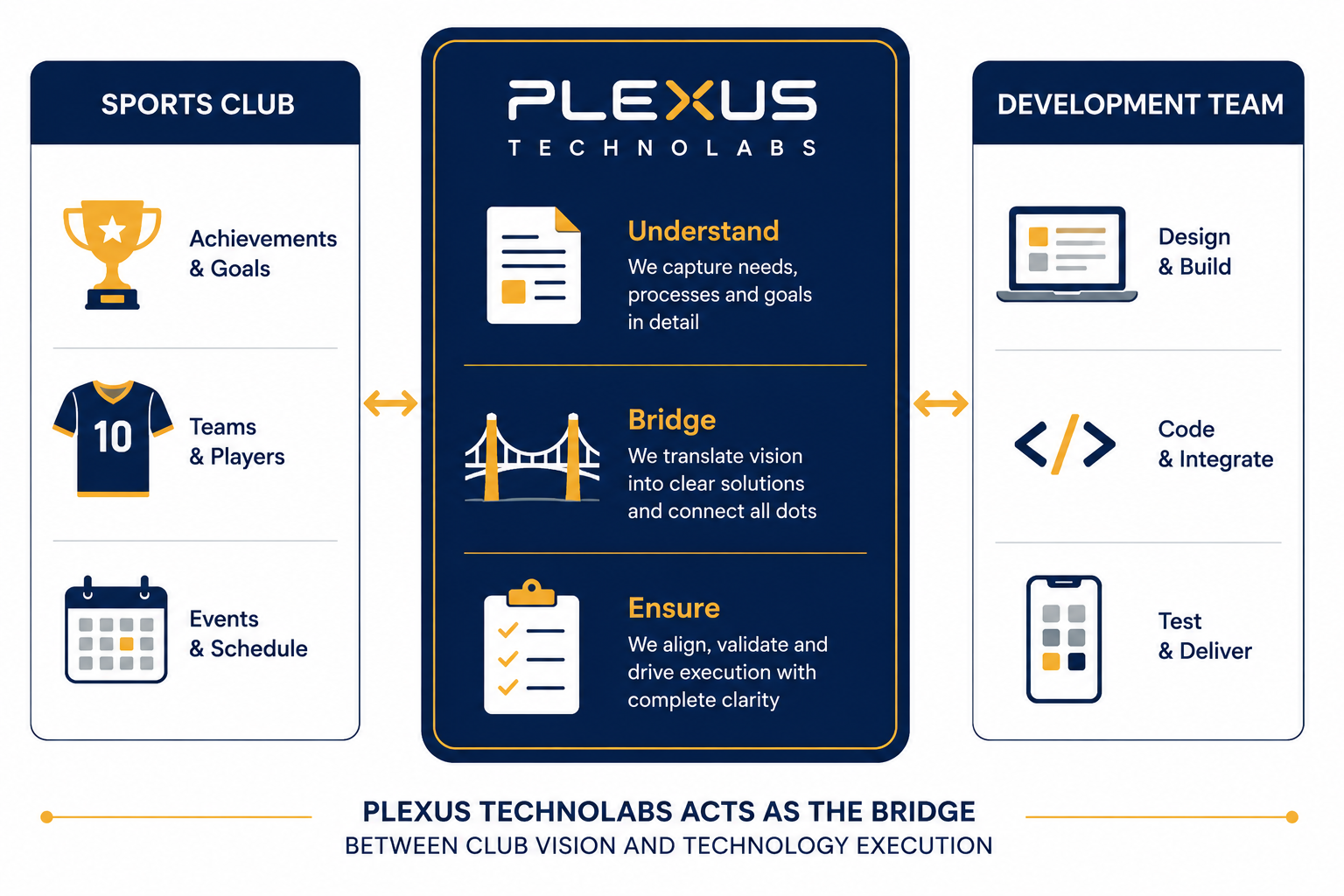
Plexus was not the development team. Plexus was the layer between the club’s vision and the team that would build it – making sure what got built matched what was actually needed.
Using the [BAaaS (Business Analysis as a Service)] framework, here is what Plexus delivered:
Requirement gathering: Plexus sat with the club team, understood exactly what they wanted the platform to do event listings, sponsor profiles, bid submission, bid visibility, winner notification, sponsorship asset allocation (jerseys, equipment, on ground branding).
Gap identification: Where the club’s brief was vague or technically impractical, Plexus pushed back and proposed alternatives before anything went to development. This prevented the most common and expensive problem in custom software builds – discovering a misunderstood requirement after the build has already started.
Technical translation: Every requirement was converted into a precise development brief. The development team received a specification they could act on without needing to interpret, assume, or go back for clarification.
Liaison throughout: Whenever the development team had a question or a constraint, Plexus translated it back to the club in plain language and translated the club’s response back to technical direction. Neither side needed to speak the other’s language. Plexus handled that.
Why Does This Role Matter in a Software Build?
Most custom software projects don’t fail because of bad development. They fail because the brief was incomplete, the requirements were misunderstood, or the business team and the tech team were never really speaking the same language. Plexus solved the same problem at a much larger scale [when helping launch a SEBI compliant fintech investment app in Ahmedabad] – the challenge of translating a complex business vision into a build-ready technical specification is industry-agnostic
For a sports club – whose expertise is in running events, not commissioning software – that gap is real and consequential. A bidding platform with unclear rules logic, broken notification flows, or a sponsor-facing interface that doesn’t match how sponsors actually make decisions is worse than no platform at all.
Plexus bridged that gap – and if you want to understand exactly how [that process works from discovery to delivery], it is the same structured approach we bring to every engagement.The club got a specification that reflected their actual vision. The development team got clarity they could build from directly.
The Outcome
A complete, development ready software specification for a sports sponsorship bidding platform – built around the club’s real workflow, validated against technical feasibility, and handed to the development team without ambiguity.
The platform, once built, gives smaller sponsors a direct, transparent route into equestrian sports event sponsorship – something the manual, relationship-driven model never offered them.
If Your Business Needs the Same
If you have a software idea but aren’t sure how to turn it into a brief a development team can actually build from – that is exactly what Plexus does.
Talk to Plexus Technolabs about your project
Frequently asked questions
What does Plexus do in a software project if they're not the developers?
Plexus acts as the business to tech bridge. They gather and structure your requirements, identify gaps before development starts, convert your business needs into precise technical specifications, and stay available throughout the build to resolve any miscommunication between your team and the developers. The result is a build that matches what you actually asked for.
How is this different from hiring a business analyst directly?
Plexus brings the BAaaS framework – a structured diagnostic approach that goes beyond requirement documentation. It challenges assumptions, flags what’s impractical before it costs you, and stays involved through delivery rather than handing over a document and stepping away.
Can Plexus help if a software project is already underway?
Yes. If a build has started but requirements are unclear, the scope has drifted, or the development team and the business team are misaligned, Plexus can step in mid project to audit what’s been specified and what still needs to be defined.
Does Plexus only work with sports and fintech clients?
No. The BAaaS framework applies to any business that needs a software solution but doesn’t have the internal capability to translate their requirements into a development-ready brief. The domain changes. The core problem – business vision not making it into the build intact – stays the same.