Why do most CRM projects fail before implementation?
Many businesses begin their CRM journey by comparing software such as Salesforce, HubSpot, Zoho CRM, Microsoft Dynamics, or Odoo. However, the biggest mistake happens before a product demonstration is ever scheduled.
Instead of asking “Which CRM should we buy?”, businesses should first ask:
“Do we actually have a customer management problem that a CRM can solve?”
A CRM is designed to organize customer relationships, sales activities, service requests, and business data. It is not designed to fix unclear processes, inconsistent follow ups, missing accountability, or poorly defined workflows.
Research shows that many CRM initiatives fail because organizations prioritize technology before defining business processes, user requirements, and adoption strategies. Businesses that achieve the best CRM outcomes spend more time understanding how work happens today than comparing software features. Gartner – CRM Strategy Research
Can a CRM fix broken business processes?
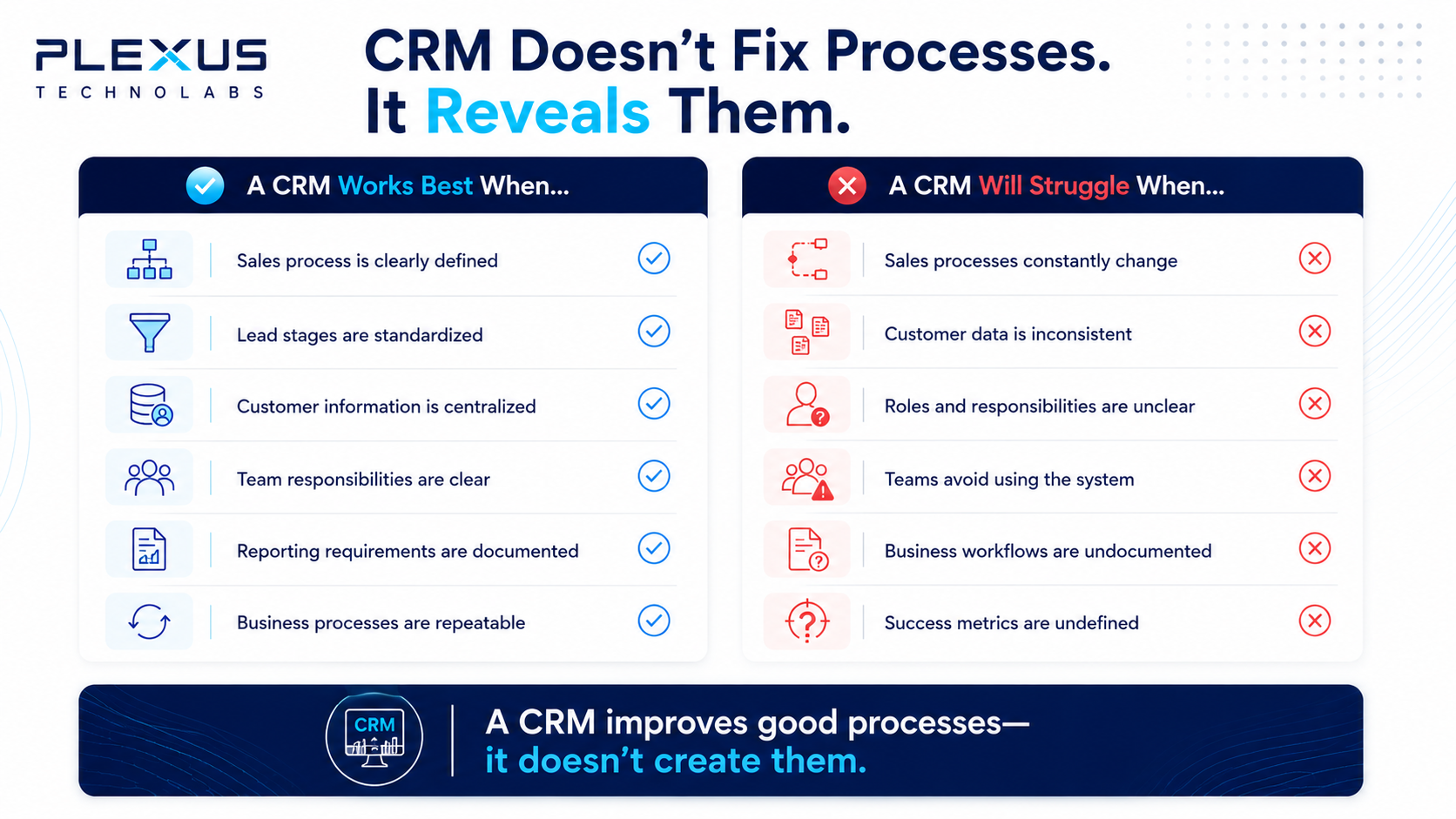
One of the biggest misconceptions about CRM implementation is that software automatically improves the way a business operates. In reality, a CRM doesn’t create better processes – it makes existing ones visible.
When sales processes are clearly defined, a CRM improves efficiency, reporting, collaboration, and customer management. However, if workflows are inconsistent or undocumented, the CRM simply exposes those issues instead of solving them.
Imagine two businesses selling the same products, operating in the same industry, and implementing the same CRM platform. One achieves rapid adoption and better reporting, while the other struggles with poor data quality and frustrated employees. The difference isn’t the software – it’s the business process behind it.
Before implementing any CRM, organizations should understand how leads enter the business, how opportunities progress through the sales pipeline, who owns each stage, which approvals are required, and what reporting management expects.
Without that clarity, even the best CRM becomes nothing more than an expensive customer database. Gartner CRM Implementation Best Practices
How do you know if your business needs a CRM?
The decision to implement a CRM has little to do with company size. Instead, it depends on how difficult it has become to manage customer relationships, sales activities, and business information manually.
A CRM becomes valuable when teams need a single source of truth for customer interactions, sales pipelines, follow-ups, and reporting. If information is scattered across spreadsheets, emails, and individual employees, a CRM can significantly improve visibility and collaboration.
Businesses often benefit from a CRM when:
> Customer information is stored across multiple systems.
> Sales follow ups are frequently delayed or missed.
> Teams struggle to access complete customer histories.
> Reporting requires significant manual effort.
> Multiple employees interact with the same customer.
If your business is still defining its sales process, changing workflows every few weeks, or rarely reuses customer information, implementing a CRM may be premature. In these situations, improving business processes should come before selecting software.
A CRM manages customer relationships – it cannot organize business chaos. Gartner – CRM Strategy Research
Why do CRM implementations fail?
Most CRM failures are not caused by the software itself. They occur because businesses implement technology before understanding how their teams actually work.
Organizations often spend months configuring dashboards, workflows, fields, and automations without first defining business requirements. As a result, employees see the CRM as additional work rather than a helpful business tool. Data quality declines, reporting becomes unreliable, and user adoption suffers.
Successful CRM implementation begins with business analysis – not software configuration. Before selecting any platform, organizations should understand their existing workflows, identify operational bottlenecks, define reporting requirements, assign clear responsibilities, and establish measurable business goals. Gartner CRM Implementation Best Practices
What should you evaluate before implementing a CRM?
Before choosing any CRM platform, businesses should gain clarity on the following areas:
> Current business workflows and how they operate today.
> Process bottlenecks that slow sales or customer service.
> Customer data requirements at every stage.
> User roles, responsibilities, and ownership.
> Reporting and dashboard requirements.
> Future business goals, scalability, and integration needs.
These factors determine whether a CRM becomes a valuable business system or simply another software subscription.
A successful CRM strategy starts with understanding the business first and selecting technology second.
How can you assess whether your business is ready for a CRM?
Before investing in any CRM platform, take a step back and evaluate whether your business processes are ready.
- Customer information is stored across multiple systems or spreadsheets
- Sales follow ups or customer communications are occasionally missed.
- Management struggles to track sales performance or pipeline activity.
- Multiple employees need access to the same customer information.
- Reporting requires significant manual effort.
If several of these apply to your business, a CRM could create measurable operational value. However, choosing the right platform is only one part of the process. Long-term success depends on process maturity, workflow design, reporting requirements, user adoption, and future business goals.
To get the complete CRM Readiness Checklist and our CRM Assessment Framework, contact Plexus. We help businesses evaluate their current processes, identify operational gaps, define CRM requirements, and determine whether a CRM, workflow improvement, or custom solution is the right next step.
Get a clear understanding of your CRM readiness before investing in software. Start with a CRM Assessment from Plexus.
Frequently asked questions
How does the Plexus CRM Assessment help my business?
Our CRM Assessment begins with understanding how your business operates today. We evaluate your sales processes, customer journey, workflow challenges, reporting needs, and business goals before recommending any CRM solution. This ensures the platform supports your operations rather than forcing your business to adapt to the software.
How do I know if my business is ready for CRM implementation?
CRM readiness depends on process maturity rather than company size. If your customer information is scattered, follow ups are inconsistent, reporting is manual, or multiple teams manage the same customers, your business may be ready. Plexus helps assess your readiness before implementation begins.
We already have a CRM. Can Plexus still help?
Yes. Many organizations already use a CRM but struggle with low user adoption, poor data quality, inefficient workflows, or unreliable reporting. Plexus evaluates your existing CRM, identifies improvement opportunities, and recommends practical changes that increase business value without unnecessary complexity.
How do you recommend the right CRM platform?
We don’t begin with software comparisons. First, we understand your business processes, operational requirements, scalability goals, integrations, and reporting needs. Based on these findings, we recommend the CRM platform or custom solution – that best supports your long term business objectives.
What do we receive after the CRM Assessment?
You’ll receive a CRM readiness assessment, process improvement recommendations, documented business requirements, platform recommendations (where applicable), implementation priorities, and a practical roadmap for successful CRM adoption.