What Can AI Actually Do for Your Business?
Most businesses don’t have an AI problem. They have a clarity problem.
Business leaders hear two very different stories about AI. One side claims AI will transform every business process. The other argues that it is unreliable and overhyped. The truth lies somewhere in between. AI is extremely effective at specific types of work, but it performs poorly in others. Businesses that understand this difference achieve measurable results. Those that don’t often invest in projects that never move beyond experimentation.
77% of organizations say AI adoption is happening faster than their ability to govern and manage it. Many businesses are implementing AI before clearly identifying where AI fits within their operations. IBM Global AI Adoption Index 2024
Before evaluating AI tools, vendors, or platforms, ask one simple question:
What type of work is AI actually good at?
AI performs tasks. It doesn’t understand business context.
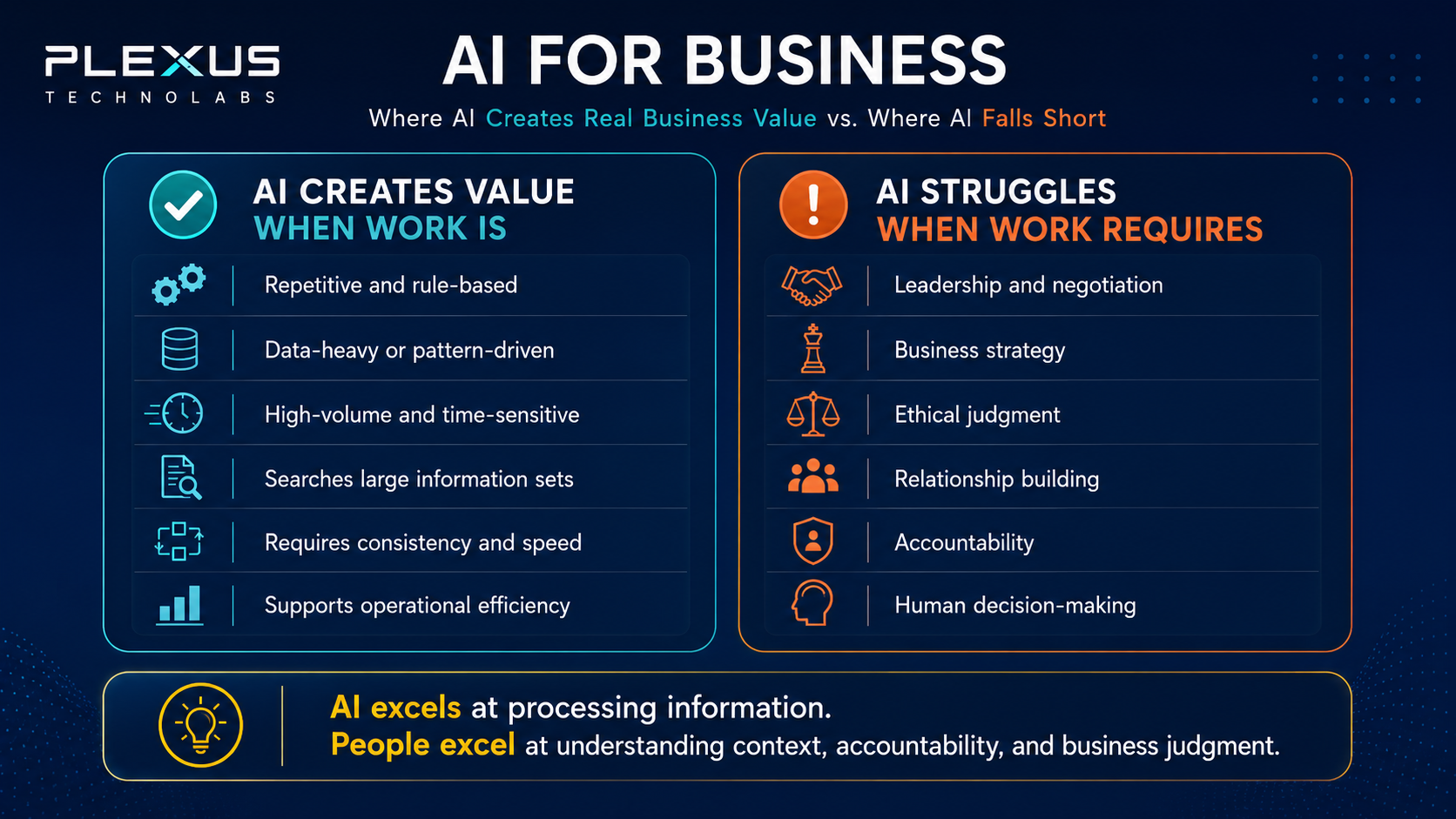
The biggest misconception about AI for business is that it behaves like an experienced employee. It doesn’t. AI excels at processing information, recognizing patterns, and completing repetitive tasks at scale.
Think about the work that consumes time across most organizations. Employees search through documents, categorize requests, summarize meetings, review reports, analyze large datasets, and answer repetitive customer questions. These activities follow predictable patterns and involve large volumes of information. This is where AI delivers the greatest value.
For example, logistics companies use AI to optimize delivery routes by analyzing traffic conditions, fuel consumption, weather, and historical delivery data. Manufacturers use computer vision to inspect thousands of products for defects in real time, allowing quality teams to focus only on exceptions. In both cases, AI doesn’t replace expertise. Instead, it removes repetitive work so people can focus on decisions, relationships, and strategy.
How businesses are actually using AI - and where it went wrong ?
The most successful AI initiatives solve operational problems rather than chasing technology trends. Across industries, businesses see the strongest results when AI supports an existing process instead of replacing it completely.
In logistics, companies such as UPS use AI powered route optimization to reduce fuel consumption, improve delivery efficiency, and shorten travel times. Instead of relying on manual planning, AI continuously analyzes traffic patterns, delivery schedules, and road conditions to recommend the most efficient routes. UPS ORION Route Optimization
In financial services, banks use machine learning to monitor millions of transactions in real time. AI identifies unusual spending patterns that may indicate fraud, allowing investigators to review only the highest-risk transactions instead of checking every payment manuall. Mastercard AI & Fraud Detection Insights
Manufacturers apply computer vision to inspect products during production. AI detects defects that are difficult to identify consistently through manual inspection, helping quality teams reduce waste while improving production efficiency. Deloitte Smart Manufacturing Report
However, AI doesn’t always deliver successful outcomes.
Amazon discontinued an experimental AI recruiting system after discovering that it had learned biased hiring patterns from historical recruitment data. Because the training data reflected past hiring decisions, the system unintentionally disadvantaged many qualified female applicants. The project demonstrated that AI can learn patterns from data – but it cannot determine whether those patterns are fair or appropriate. Reuters – Amazon Recruiting AI
More recently, Workday faced a U.S. lawsuit alleging that its AI-powered hiring tools may have contributed to discriminatory hiring outcomes. While the legal process is ongoing, the case reinforces an important lesson for every business leader: AI recommendations still require human oversight, governance, and accountability. Reuters – Workday AI Hiring Lawsuit
Why most AI projects fail before they even start ?
Many AI projects fail long before the technology becomes the problem. In most cases, the biggest challenges are unclear business objectives, poor data quality, and unrealistic expectations.
Businesses often start by selecting an AI tool before understanding the process they want to improve. As a result, teams automate inefficient workflows instead of solving the underlying business problem. AI can accelerate a process, but it cannot fix one that is already broken.
Another common issue is data quality. AI depends on accurate, consistent, and well structured information. If business data is incomplete, outdated, or spread across multiple systems, the quality of AI outputs will suffer regardless of the platform being used.
Many organizations also expect AI to deliver immediate transformation. In reality, successful AI adoption is usually incremental. Businesses achieve better outcomes by starting with a clearly defined use case, measuring results, and expanding only after demonstrating measurable value.
The most successful AI projects begin with business analysis not technology selection. Understanding processes, identifying repetitive work, and defining measurable objectives creates a much stronger foundation for long-term success.
McKinsey – The State of AI | NIST AI Risk Management Framework
What AI cannot do reliably ?
Many businesses become disappointed with AI because they expect it to solve problems it was never designed to solve. AI can generate answers, but it cannot guarantee those answers are correct. It can identify patterns, but it cannot determine whether those patterns are fair, ethical, or aligned with business objectives.
Businesses should be cautious when applying AI to hiring decisions, legal judgments, employee evaluations, strategic planning, and sensitive customer disputes. In these situations, the cost of a poor decision is often much greater than the efficiency gained through automation.
AI should support human decision making – not replace business accountability.
Is your business ready for AI?
Before investing in AI for business, ask whether these situations exist within your organization.
- Employees repeatedly perform the same tasks every day.
- Teams spend significant time searching for documents or information.
- Business processes follow clear and repeatable workflows.
- Employees manually review large amounts of data before making decisions.
- Customers frequently ask the same questions.
If several of these apply to your business, AI can likely create measurable value. However, identifying the right opportunities requires more than a quick assessment. It requires a structured evaluation of your business processes, data readiness, and operational goals.
To get the complete AI Readiness Checklist and our AI Opportunity Assessment Framework, contact Plexus. Our team helps businesses identify high impact AI use cases, assess implementation readiness, and build practical AI roadmaps aligned with real business outcomes before investing in technology.
Ready to identify the right AI opportunities for your business ?
Frequently asked questions
How does the Plexus AI Opportunity Assessment Framework help my business?
Our AI Opportunity Assessment Framework helps you identify where AI can create measurable business value before you invest in technology. We evaluate your business processes, identify repetitive and high impact tasks, assess data readiness, and prioritize AI opportunities based on feasibility, business impact, and ROI. The outcome is a practical roadmap tailored to your business objectives.
How do I know if my business is ready for AI?
AI readiness isn’t determined by company size, it’s determined by process maturity. If your teams spend time on repetitive tasks, manual data analysis, document heavy workflows, or recurring customer requests, your business may already have strong AI opportunities. Plexus assesses your processes, data, and operational readiness to help you determine where to start.
We already use AI tools. Can Plexus still help us?
Yes. Many businesses adopt AI tools without a clear implementation strategy. Plexus helps evaluate your existing AI initiatives, identify gaps, optimize current workflows, and uncover additional opportunities that deliver greater business value. Our focus is on maximizing outcomes – not simply recommending new technology.
How do you identify the right AI use cases for our business?
We begin by understanding your business goals and current operations. Our team maps your workflows, analyzes repetitive and time consuming activities, evaluates available data, and identifies areas where AI can improve efficiency, decision making, or customer experience. Every recommendation is aligned with measurable business outcomes rather than technology trends.
What do we receive after the AI Opportunity Assessment?
At the end of the assessment, you’ll receive a prioritized list of AI opportunities, an AI readiness evaluation, recommended implementation priorities, potential business benefits, and a practical roadmap for adoption. This enables you to make informed investment decisions with confidence and avoid costly AI initiatives that lack clear business value.