How a WhatsApp Chatbot for Fintech Companies Automates Client Support and Reduces Repetitive Queries
Most investment firms don't have a relationship problem. They have a routing problem.
A WhatsApp chatbot for fintech companies helps automate repetitive queries such as portfolio checks, SIP status, and document requests, allowing relationship managers to focus on client interactions.
One investment firm with 2,200+ active clients was spending significant time handling routine requests. After mapping the query flow, Plexus identified the bottlenecks and redesigned the support process without expanding the team.
Here's where the overload originated and how it was resolved.
Benchmark Sources — 1. WABB India | 2. CoinLaw | 3. ChatArchitect | 4. Unblu
Why Are Fintech and Investment Firms Struggling to Scale Client Servicing Without a WhatsApp Chatbot for Fintech Companies?
India’s investment services sector is growing rapidly, increasing the volume of client queries support teams handle every day.
The challenge is no longer acquiring clients. It is servicing them efficiently at scale. Many firms still rely on manual responses for portfolio checks, SIP status requests, and document updates.
A WhatsApp chatbot for fintech companies helps automate these routine interactions, enabling faster responses while allowing relationship managers to focus on higher-value client conversations.
What Was the Relationship Management Team Actually Doing Every Day?
An investment services firm managing 2,200+ active clients approached Plexus Technolabs with a growing operational challenge.
Instead of focusing on client relationships, the team spent much of its day handling routine requests such as portfolio value checks, SIP status updates, document reminders, and transaction confirmations.
Every query followed the same manual process: retrieve information, draft a response, and send it. There was no automation, self service, or query prioritization.
A WhatsApp chatbot for fintech companies could automate these repetitive interactions, freeing relationship managers to focus on conversations that require expertise and judgment.
What Was Structurally Breaking the Client Servicing Workflow?
Portfolio values, SIP status, pending documents, and transaction history accounted for most incoming requests..
Each client message needed a team member to retrieve information and respond individually. No automation or self service options were available.
Routine queries consumed valuable time, reducing the team's ability to focus on client engagement, retention, and relationship building.
What Did Plexus Find Before Recommending a WhatsApp Chatbot for Fintech Companies?
Before recommending any technology, Plexus mapped the firm's client servicing workflow using our BAaaS (Business Analysis as a Service) approach. The assessment revealed three key findings.
The Real Problem
Nearly 60 - 70% of client queries were routine requests that did not require a relationship manager. The issue was the lack of an automated first line of support.
Where the Bottleneck Was Actually Forming
All client queries entered the same queue, causing routine requests and advisory conversations to compete for the same resources.
The Decision
Plexus recommended a WhatsApp chatbot for fintech companies with secure client verification, self service access for routine queries, and escalation to relationship managers when needed.
How Did Plexus Build a WhatsApp System That Resolves Routine Queries Automatically - Without Removing the Human Where It Matters?
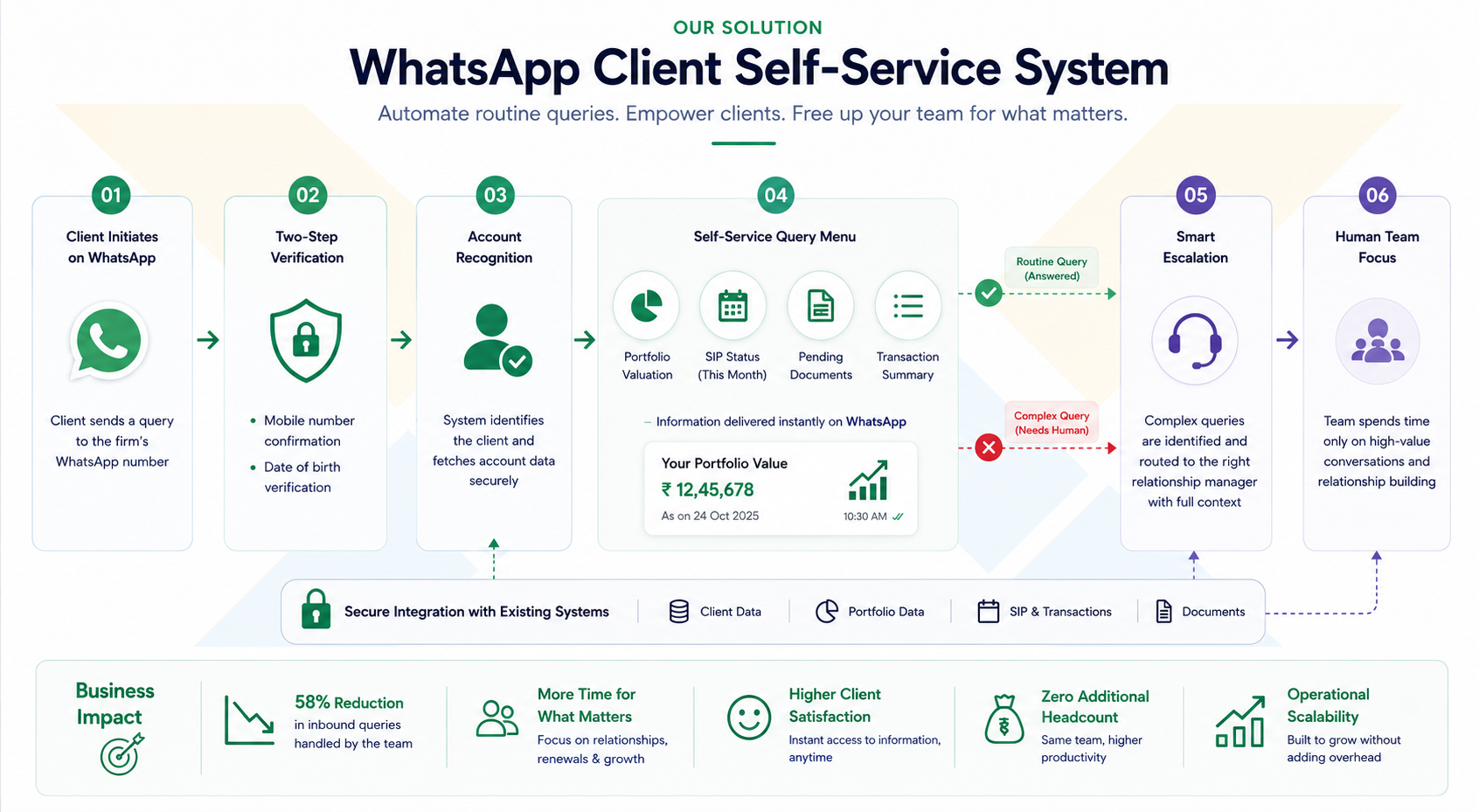
Plexus built a automated self service workflow to handle routine fintech queries, protecting the human layer for high value client interactions.
Before any query is answered, the client is verified — mobile number plus date of birth. This is the security foundation of the entire system. No data is surfaced without confirmed identity. For an investment firm managing 2,200+ clients' financial information, this step isn't optional - it's what makes automated query handling for investment firms possible without compromising client data.
Once verified, the client's account is recognised, and then a structured query menu is presented - Portfolio Value, SIP Status, Pending Documents, Transaction History. Four categories. Every routine query covered. The client selects what they need. The system knows who they are and what to surface.
a collection without manual effort.
The selected query is resolved instantly, no queue, no wait, no team involvement. Portfolio value pulled live. SIP status confirmed. Document checklist shared. Transaction history retrieved. The client gets their answer in seconds, on WhatsApp, at any hour. This is what WhatsApp customer service automation for fintech India looks like in practice.
Not every query fits a menu. The system is built to recognise when a client's message falls outside routine categories, a complaint, an investment question, an account change request. These are flagged automatically and moved to escalation. The relationship manager doesn't get everything. They get only what genuinely needs them.
Complex, flagged queries are routed directly to the relevant relationship manager - with client context already attached. The RM doesn't start from scratch. They know who the client is, what they asked, and what the automated system couldn't resolve. The conversation starts informed. For investment firms and financial advisors across Gujarat and across India, this is the layer that makes deploying a WhatsApp chatbot for financial services genuinely scalable - routine queries handled automatically, relationship level conversations handled by humans who are fully prepared to have them
What Did the Relationship Management Team's Day Look Like After the System Went Live?
| Category | Before Plexus | After plexus |
|---|---|---|
| Query Handling | Every query - routine or complex, routed manually through the team | 60 - 70% resolved automatically via WhatsApp self-service, zero team involvement |
| Response Time | Dependent on team availability - inconsistent, often delayed | Instant automated response for routine queries, any time of day |
| Relationship Manager Time | Majority spent on repetitive lookup and response | Protected for complex, high value client conversations only |
| Scaling Cost | Every new client added directly to support workload and headcount pressure | Client base scales without proportional increase in support team size |
| Client Experience | Inconsistent - varied by team availability and query queue length | Consistent, instant, available 24/7 on the channel clients already use |
| Team Productivity | Diluted across volume - high value work crowded out by routine tasks | Concentrated on conversations that build retention, trust, and wallet share |
The company didn’t scale by hiring more support staff. Instead, it scaled through a WhatsApp chatbot for fintech companies that handled repetitive requests automatically while preserving the relationship-driven conversations clients still expect. It scaled by stopping routine communication from flowing through people unnecessarily. This isn’t unique to one firm – across most Indian businesses, 60 – 75% of customer support queries can be resolved through WhatsApp customer service automation, with no human agent involved. This system proved the same pattern holds in fintech and wealth management.
What changed wasn’t the team. It was what the team was doing – spending their time on [conversations that build retention, trust, and wallet share] instead of answering the same four questions every day.
Key Takeaways
A WhatsApp chatbot for fintech companies doesn't replace relationship managers - it removes the 60 - 70% of queries that never needed a human in the first place
80% of client queries in major financial institutions are now handled automatically - firms still routing everything manually are losing ground on their ability to reduce repetitive queries in financial services at scale
Two-step verification is what makes automated query handling for investment firms secure enough to trust - identity first, information second
Smart escalation protects the relationship manager's time without removing the human touch - the RM gets only what genuinely needs their judgment
BAaaS means Plexus maps the full query flow before recommending anything - the automation only works because the diagnosis came first
Is Your Client Servicing Team Answering the Same Questions Every Day?
Frequently asked questions
Is a WhatsApp chatbot for fintech companies secure enough for sensitive client data ?
Yes, and security is built into the first step. Every interaction begins with two-factor client verification before any account information is surfaced. No data is shared without confirmed identity. The WhatsApp Business API fintech India deployment uses Meta’s official enterprise grade infrastructure – not a third-party workaround – and is compliant with the data handling standards that investment firms operating in India are required to maintain.
What happens to queries the chatbot can't resolve?
They’re automatically identified as complex and escalated to the relevant relationship manager – with full client context attached. The RM receives the query already knowing who the client is and what they asked. Nothing gets dropped. Nothing gets lost.
Will clients find it impersonal to interact with an automated system?
The experience is designed to feel like a fast, structured first response – not a replacement for a human. Clients get their routine answers instantly, on WhatsApp, without waiting. The relationship manager appears exactly when the conversation needs depth. Most clients prefer the speed. What they don’t prefer is waiting an hour for a portfolio balance.
Does this require replacing our existing CRM or client management system?
No. Plexus builds the WhatsApp automation layer to work with your existing infrastructure. The goal is to automate client queries in fintech without disrupting anything that’s already working – the CRM, the client database, and the team structure all stay exactly as they are. The WhatsApp Business API integration connects on top of existing systems, no migration, no overhaul, no operational disruption.
How long before the system is live and handling queries?
Plexus doesn’t build the chatbot from scratch – it deploys a proven third – party WhatsApp platform with custom workflow logic, qualification questions, and escalation rules designed around your query categories. No custom development means lower cost, faster go-live, and immediate ROI. Most investment firms are live and handling queries automatically within 2 – 3 weeks of workflow mapping completion.