How AI Surveillance for Manufacturing Plants Improves Safety, Visibility, and Operational Efficiency
One developer reached out to Plexus with this very challenge. They had the leads, the sales team was putting in the effort, and the CRM was operational. Yet, the conversion rates didn’t reflect that hard work.
When Plexus dug into the actual workflow, focusing on the process instead of just the tools or the team – it completely changed the way this business operated. Here’s what was broken, what was it costing & How plexus fixed it.
Benchmark Sources — 1. PMF IAS, 2. Scanalitix, 3. LinkedIn
Why Are Manufacturing Plants Investing in CCTV But Still Missing What Matters Most?
India’s manufacturing sector is growing rapidly, and CCTV systems are now common across factories. Yet many preventable safety incidents continue to occur.
According to DGFASLI, three factory workers lose their lives every day in registered industrial establishments due to preventable safety failures. Gujarat also records the highest number of factory deaths among Indian states. DGFASLI Annual Factory Inspection Data
The issue is not the lack of cameras. Traditional CCTV systems record events but do not detect risks or send alerts. As a result, teams often discover safety violations and operational issues only after an incident.
AI Surveillance for Manufacturing Plants changes this approach. It continuously monitors operations, detects anomalies, and sends real time alerts that help teams act before problems escalate.
India’s video surveillance market is expected to grow from $7.5 billion in 2025 to $19.5 billion by 2034, driven by demand for intelligent surveillance solutions.
What Was Actually Happening on the Factory Floor Every Shift?
The manufacturing plant already had CCTV cameras across the facility. However, the system functioned only as a recording tool.
Supervisors manually checked PPE compliance, monitored restricted areas, tracked machine downtime, and managed attendance records. Most issues were identified only after reviewing footage.
According to Scanalitix, many industrial accidents result from weak supervision and inadequate inspections rather than a lack of cameras. Adding an AI intelligence layer enables real time monitoring, automated alerts, and faster response to safety and operational issues.
What Was the Existing CCTV Setup Failing to Catch?
Helmet and PPE violations were usually identified during inspections or after an incident. The system provided no real time alerts.
The cameras recorded restricted area entries, but teams discovered unauthorized access only after reviewing footage.
Machine downtime often came to light only after production delays affected output, resulting in lost productivity
Supervisors had to monitor multiple camera feeds manually. Incidents could be missed when no one was watching the relevant screen.
What Did Plexus Find When They Assessed the Facility Before Touching a Single Camera?
Before recommending a solution, Plexus assessed the existing surveillance system, monitoring processes, and operational workflows. Following our BAaaS (Business Analysis as a Service) approach, we identified three key findings.
The Real Problem
The CCTV system recorded events but provided no actionable insights, real time detection, or automated alerts.
Where Every Blind Spot Was Forming
Safety violations, unauthorized access, and machine downtime depended on manual monitoring, making consistent oversight difficult across shifts and locations.
The Decision
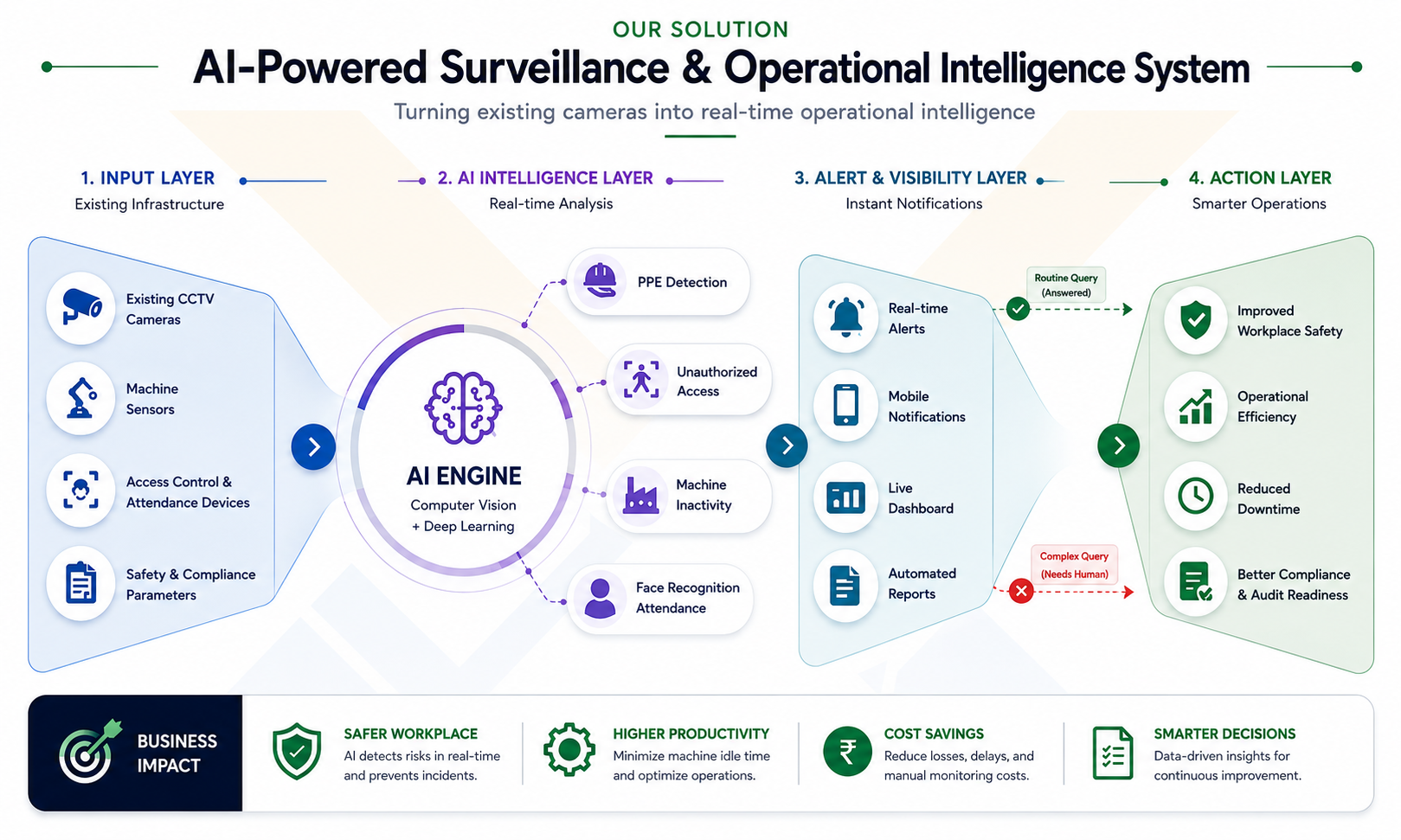
Plexus recommended deploying AI Surveillance for Manufacturing Plants on top of the existing CCTV infrastructure, turning recorded footage into an intelligent monitoring system without replacing cameras.
How Did Plexus Turn Existing CCTV Into a Real Time AI Monitoring System - Without Replacing a Single Camera?
Here's the AI surveillance workflow Plexus designed and implemented
The AI monitoring engine analyses every live camera feed simultaneously - detecting helmet non-compliance, missing PPE, and safety violations the moment they occur. AI manufacturing surveillance cameras detect helmet and PPE non compliance in real time and raise alerts to the safety officer, with details of the exact location within the plant where the breach occurred. No manual round required. No waiting until after the shift to discover what went wrong
Every restricted zone is defined within the AI system. The moment an unauthorised person enters - regardless of shift, regardless of whether a supervisor is watching - an instant alert is triggered. Unauthorised access detection on CCTV moves from reactive discovery to real-time prevention.
The AI engine tracks machine activity across every production zone continuously. When a machine goes idle unexpectedly, the system flags it immediately - alerting the operations team before a production gap builds. Machine idle time monitoring through AI replaces the delayed discovery of manual rounds with instant, shift-wide visibility.
What Changed on the Factory Floor After the AI Monitoring System Went Live?
| Category | Before Plexus | After plexus |
|---|---|---|
| Safety Violation Detection | Caught during manual rounds or after an incident - often too late | Detected in real time by AI the moment a violation occurs - instant alert to safety officer |
| Restricted Zone Access | Discovered after the fact, if at all - no automated detection | Flagged instantly the moment unauthorized entry occurs - regardless of shift or supervisor presence |
| Machine Idle Time | Noticed during rounds or via end-of-day production gaps | Detected immediately when a machine stops - operations team alerted before losses accumulate |
| Attendence Tracking | Manual registers - inaccurate, inconsistent, open to error | Face recognition attendance system logs every worker entry automatically in real time |
| Incident Monitoring | Entirely dependent on supervisor presence at the right moment | AI monitors every zone simultaneously across every shift - nothing depends on a human being in the right place |
| Operational Visibility | Fragmented across zones - no single view of facility-wide activity | Centralized dashboard delivers live, unified visibility across the entire plant at all times |
Every one of these changes happened on the same camera infrastructure the plant already had.
The [operations team alerted before losses accumulate] —that’s not a hardware outcome. That’s what an intelligence layer delivers
Key Takeaways
The cameras weren't the problem - the absence of AI surveillance for manufacturing plants interpreting their feed was. Same hardware. Completely different operational output
Three factory workers die every day in India due to preventable safety failures, per DGFASLI - most linked to weak supervisory systems that a real-time AI monitoring layer directly addresses
Real-time PPE compliance detection removes the dependence on manual rounds for safety enforcement - violations are caught the moment they occur, not after
Face recognition attendance eliminates manual logging entirely - accurate, automatic, shift-wide, with zero human input required.
BAaaS means Plexus maps every surveillance gap before recommending anything - the AI layer is built around what the facility actually needs, not a generic template
Are Your CCTV Cameras Recording Everything But Telling You Nothing?
Frequently asked questions
Does this require replacing existing CCTV cameras?
No. Plexus builds the AI monitoring engine on top of your existing camera infrastructure. The same cameras that were only recording now feed into an AI system that detects, alerts, and reports – no hardware replacement, no facility disruption.
How does PPE compliance detection actually work in a live factory environment?
The AI engine analyses the video feed from existing cameras in real time – identifying whether workers in the frame are wearing required safety equipment. When a violation is detected, an alert is sent instantly to the designated safety officer with the location of the breach. No human needs to be watching the monitor.
Can the system handle multiple shifts and multiple zones simultaneously?
Yes, and this is precisely where AI surveillance outperforms manual supervision. The system monitors every connected camera feed simultaneously, across every zone, across every shift, without fatigue, gaps, or dependency on who is available to watch.
How accurate is face recognition attendance in a manufacturing environment?
The system is built for factory conditions – variable lighting, protective gear, high worker throughput at shift changes. Recognition accuracy runs above 95% once the initial database is established. Manual override options exist for edge cases so no shift record goes unlogged.
How long does it take to go from existing CCTV to a live AI monitoring system?
Plexus doesn’t replace your camera infrastructure or build surveillance software from scratch – it deploys a proven AI monitoring engine on top of your existing setup, with detection rules, zone configurations, and alert logic custom-designed for your facility. Most manufacturing plants are live with real-time safety monitoring and automated alerts within 3 – 4 weeks of the facility assessment completion.