How Plexus Helped Ocean Finvest Launch "InXits" - Their First AI Powered Investment App
Ocean Finvest had a vision. A SEBI registered investment advisory firm with 3,000+ clients across Gujarat, they wanted to give every investor something most platforms don't - a clear understanding of their own investment psychology. What they needed was a trusted partner who could turn that vision into a working, compliant, integrated product. That partner the bridge between their vision and the team building it was Plexus Technolabs
Who Is Ocean Finvest, and What Is InXits?
Founded in 2014, Ocean Finvest is one of Gujarat’s most established SEBI certified investment advisory and research analyst firms (SEBI Registration: INA000020369 | INH000019460). With offices across Ahmedabad, Surat, Mumbai, Rajkot, Bhopal, and Pune, they serve thousands of investors across Western India.
Their new product – InXits – is an AI powered, account aggregator based investment app. It goes beyond standard portfolio tracking. InXits maps each investor’s psychological risk profile, consolidates their full financial picture through the Account Aggregator framework, and delivers personalised investment guidance based on their actual behaviour, goals, and risk tolerance – not just their age and income.
It’s a meaningful step forward in how retail investment advisory works in India. Mobile applications now command 67.83% of India’s fintech market, with the wealthtech segment scaling rapidly on the back of AI powered advisory tools. (Mordor Intelligence) InXits sits squarely at this intersection.
The challenge wasn’t the idea. It was the execution – specifically, the gap between a financial advisory firm with deep domain expertise and a technical development team that needed every business requirement translated precisely before a single line of code was written.
What Problem Was Plexus Actually Solving?
Ocean Finvest knew their product. They understood their investors, the compliance requirements, and what the app needed to deliver.
What they didn’t have was a structured layer between their business thinking and the development team’s technical execution.
This is a gap that kills more fintech launches than funding ever does. PwC’s 2025 Global Compliance Study found that 82% of financial firms plan to invest in technology to automate compliance activities but technology investment without clear business to tech translation consistently results in misaligned builds, missed regulatory requirements, and delayed launches. (Appinventiv)
Ocean Finvest needed someone who could sit in every meeting, understand what the business was asking for, and communicate exactly what that meant in technical terms – and then hold both sides accountable to the outcome.
That is precisely what Plexus was brought in to do.
What Did Plexus Actually Do - End to End?
Plexus didn’t write the code. Plexus made sure the code was right.
Business requirement analysis: Every stakeholder meeting with Ocean Finvest was attended by Plexus. Requirements were documented, challenged where necessary, and structured into clear technical briefs that the development team could act on without ambiguity.
Insight and advisory: Plexus didn’t just listen they pushed back where needed. If a feature was technically possible but commercially impractical, or if a workflow would create compliance risk under SEBI’s Investment Advisers Regulations, Plexus said so before development began, not after.
Technical translation via BAaaS: Using the [BAaaS (Business Analysis as a Service)] framework, Plexus decoded every business requirement into precise technical language – converting “we want investors to understand their psychology” into a structured AI model brief, a risk profiling workflow, and an Account Aggregator integration spec.
10+ integrations managed: Plexus coordinated and oversaw more than ten integrations across the platform – including SEBI regulatory compliance infrastructure, payment gateway connections, the Account Aggregator framework, and multiple third-party financial data APIs. Each integration required both business side clarity (what should this do for the user?) and technical side precision (how does it connect without breaking the compliance layer?).
AI chatbot implementation: Plexus guided the integration of an AI chatbot within the app – the same type of client facing automation layer Plexus has implemented for [investment firms managing repetitive client queries]. ensuring it operated within the boundaries of SEBI’s registered research analyst framework while delivering personalised, contextual support to users.
Ground level project monitoring: Throughout the build, Plexus monitored execution on both sides. When the business team and the development team had conflicting interpretations, Plexus resolved it. When a technical constraint required a business side adjustment, Plexus communicated it – and proposed the alternative.
The result: No delays caused by miscommunication. No rework from misunderstood requirements. No compliance gaps discovered after build.
What Made This Engagement Different From a Standard Tech Project?
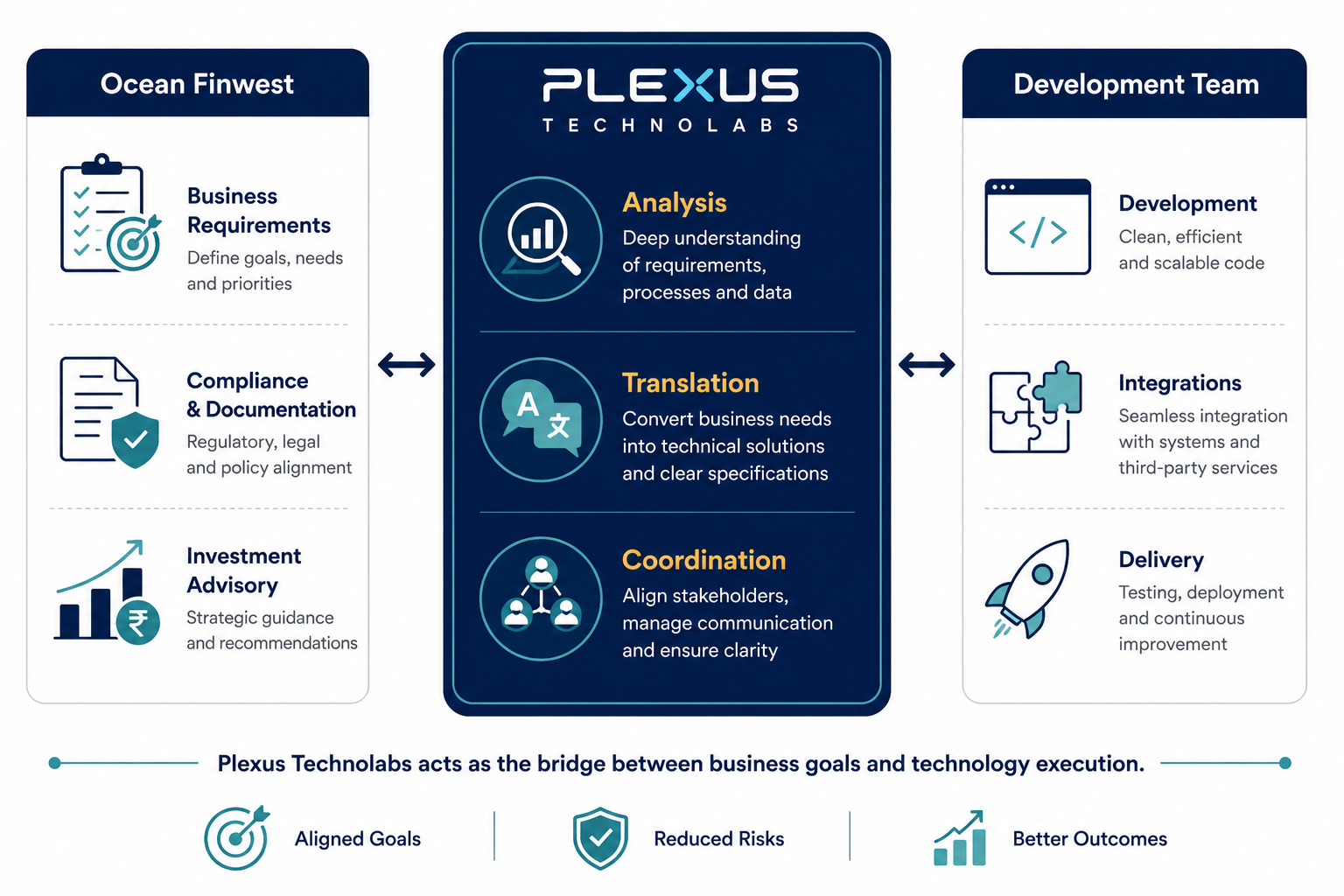
Technology was not the primary challenge. The real issue was converting business requirements into clear, buildable specifications that developers could execute without ambiguity.
Ocean FinVest understood financial markets, investor behaviour, and SEBI compliance. The development team understood software delivery. Without a bridge between the two, misunderstandings could easily slow the project or create gaps in execution.
Rather than acting as a traditional vendor, Plexus translated business objectives into technical requirements and ensured both sides remained aligned throughout the engagement.
Business Analysis as a Service was not limited to requirement gathering. A dedicated business analyst remained involved from discovery and planning through development, testing, and go-live, ensuring decisions stayed aligned with business goals.
Business Analysis as a Service was not limited to requirement gathering. A dedicated business analyst remained involved from discovery and planning through development, testing, and go live, ensuring decisions stayed aligned with business goals.
With a clear business to technology bridge in place, the platform launched on schedule, met regulatory requirements, and reflected the original business vision without costly rework.
The Outcome
InXits launched successfully and Plexus was in every meeting, every integration discussion, and every specification review that made that possible The app is live, SEBI compliant, fully integrated, and operating exactly as Ocean Finvest envisioned it.
10+ integrations completed. AI powered investor psychology mapping live. Account Aggregator framework operational. Payment infrastructure connected. Every feature built to the original business specification – because every specification was written precisely enough to build from.
For a SEBI registered firm launching its first AI powered investment platform, that outcome isn’t just a product launch. It’s the foundation for scale.
If Your Business Is Planning Something Similar
Launching a fintech product in India involves regulatory compliance, multiple third party integrations, and a development team that needs precise direction to build what you actually mean – not what they assume you mean.
If you’re at any stage of that process – from early requirements to mid build – Plexus can step in as your business to tech bridge.
What exactly does a business analyst do during a fintech app launch?
Frequently asked questions
Does AI lead qualification work for smaller real estate teams or only large developers?
A fintech business analyst translates business requirements into technical specifications the development team can act on, manages stakeholder communication between both sides, flags compliance risks before they become build problems, and monitors execution throughout the project. In complex fintech builds with multiple integrations, this role is what keeps the project aligned from start to launch.
How did Plexus handle SEBI compliance requirements during the InXits build?
Plexus reviewed every feature and workflow against SEBI’s Investment Advisers Regulations and Research Analyst framework before it was built. Where a feature created compliance risk, Plexus flagged it at the requirement stage – not after development. This meant no rework and no compliance gaps at launch.
Does Plexus only work with fintech companies in Ahmedabad and Gujarat?
No, Plexus works with businesses across India. However, as a Gujarat based consultancy, Plexus has particular depth working with SEBI-registered firms and financial services companies operating out of Ahmedabad and Western India, where regulatory and market familiarity adds direct value.
How many integrations did Plexus manage for InXits?
10+ integrations – including SEBI regulatory infrastructure, the Account Aggregator framework, payment gateways, and multiple financial data APIs. Plexus managed both the business-side definition of what each integration needed to deliver and the technical coordination to ensure each one was implemented correctly.
Can Plexus help if a fintech build is already underway but isn't going well?
Yes. Plexus can step into an active project at any stage – requirements, mid-build, or pre launch – to audit what’s been specified, what’s been built, and where the gaps are. The BAaaS framework works as a diagnostic as well as a launch methodology.