How Interior Designers Can Manage Multiple Projects with ERP & WhatsApp Integration
Winning projects is only the beginning for many interior design firms. Managing multiple sites, materials, expenses, and team coordination often becomes the bigger challenge.
One firm had the ERP, teams, and project data in place. However, information remained scattered across systems, spreadsheets, and chats. Even with an interior design ERP WhatsApp integration, project updates, approvals, and site communication lacked a unified workflow.
When Plexus mapped the flow of information, the issue was clear: the tools existed, but the connections between them did not. Fixing that gap transformed how projects were managed and monitored.
Benchmark Sources — 1. Project Delays | 2. Wasted Hours | 3. Faster Approvals | 4. Higher Profits
Why Are Interior Design Firms Drowning in Projects But Starving for Visibility?
India’s interior design sector is growing rapidly, with more residential and commercial projects being managed simultaneously, according to [Ken Research’s India Interior Design Market report].
As project volumes increase, visibility becomes a challenge. Expenses, inventory, procurement, and site updates are often spread across multiple systems, spreadsheets, and WhatsApp conversations.
Even firms with ERP systems struggle because information remains fragmented. The result is delayed visibility, slower decisions, and increased dependence on the founder for operational coordination.
This is not a technology problem. It is a visibility problem.
What Was the Founder Actually Doing Every Single Morning?
An interior design firm managing multiple projects approached Plexus Technolabs with a common operational challenge.
Although an ERP system was in place, critical updates still required calls, WhatsApp messages, and manual follow-ups. The founder spent significant time gathering information from different teams before making decisions.
The data existed across the business. What was missing was a clear, consolidated view of operations.
What Was Fragmenting the Founder's View Across Every Project?
Expenses were spread across multiple sites, making it difficult to track project spending against budgets without manual effort.
Materials moved between projects, but tracking remained fragmented, leading to stock discrepancies and procurement inefficiencies.
Operational updates required direct calls and messages instead of flowing automatically through a centralized system. According to [Aura Startup Partners], business owners spend 36% of their working time on administrative tasks.
Site updates, procurement information, and ERP records existed in different places, creating an incomplete operational picture.
According to [ECI Solutions], ERP systems can reduce decision-making time by 36% when data is current and accessible.
There was no single view of project status, expenses, inventory, and site activity across all active projects.
What Did Plexus Find When They Mapped the Information Flow Before Touching Anything?
Before recommending any solution, Plexus mapped the operational workflow using our BAaaS (Business Analysis as a Service) approach.
The assessment revealed three key findings.
The Real Problem
The ERP contained the required data, but it was not automatically consolidated and delivered to decision-makers.
Where the Visibility Gap Actually Lived
The issue was not the ERP or the team. The gap existed between data being recorded and leadership receiving timely, actionable information.
The Decision
Plexus recommended connecting the existing ERP with WhatsApp to automate daily reporting, project expense tracking, and inventory summaries. This delivered critical updates automatically without changing the existing workflow.
How Did Plexus Build a System That Delivers Operational Clarity Without Anyone Sending a Single Manual Update?
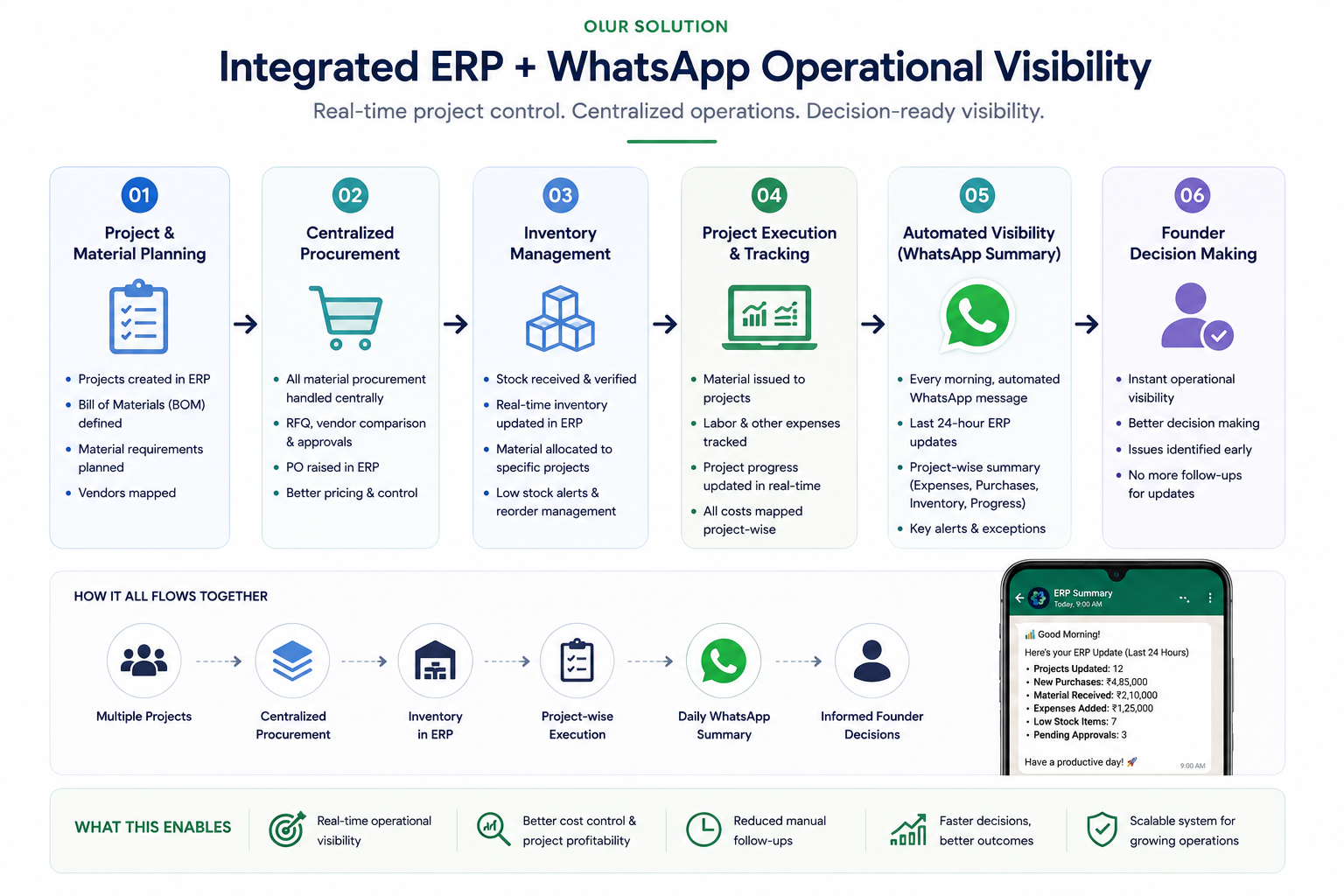
Here's the integrated workflow Plexus designed and implemented
Every active project residential or commercial - is set up inside the ERP with its own budget allocation, procurement plan, and expense tracking structure. This becomes the single source of truth for everything that follows. No project moves forward without a structured ERP entry. This step is what makes every downstream automation possible.
All material procurement is logged centrally against specific projects. Inventory movement between sites is tracked in real time inside the ERP - so the system always knows what was ordered, what arrived, what was used, and what's still outstanding. No more over-ordering. No more discovering discrepancies after delivery.
Every expense — from material purchase to labour cost - is captured against the relevant project in real time. The ERP maintains a running project wise expense view that updates automatically as entries are made, giving a live budget vs. actual picture across every active site simultaneously.
Site teams log updates directly into the ERP - procurement receipts, material consumption, expense entries. The system consolidates these automatically across all projects, maintaining a current, accurate operational picture without requiring manual compilation from anyone.
Every morning, before the workday begins, the system automatically compiles the previous day's activity from the ERP - project wise expense summary, inventory status, procurement updates, flagged discrepancies - and delivers it directly to the founder's WhatsApp as a structured daily report.
What Did the Founder's Day Look Like After the System Went Live?
| Category | Before Plexus | After plexus |
|---|---|---|
| Morning Routine | 2 hours of calls, messages, and manual information chasing | WhatsApp summary already waiting - complete before the workday starts |
| Project Expense Visibility | Manual queries per project, always delayed | Real-time project expense tracking - live, automatic, project-wise |
| Inventory Tracking | Inconsistent, site-dependent, discovered late | Centralised inventory and procurement tracking updated in real time |
| Decision Making Speed | Delayed by hours - decisions made on incomplete data | Decisions made on current data, first thing every morning |
| Team Follow Ups | Daily manual follow-ups from the founder to every site | Zero manual follow-ups - updates flow automatically into the ERP |
| Operational Control | Fragmented across calls, chats, and partial ERP entries | This is what [operational clarity without chasing people] actually looks like in practice |
Key Takeaways
- The problem wasn't missing data, it was missing visibility. The ERP had everything. Nothing was surfacing it automatically to the decision-maker
Business owners spend 36% of their working time on administrative tasks, automated reporting eliminates the largest chunk of that without changing how teams work.
Centralised inventory and procurement tracking tied to individual projects prevents over-ordering and cost overruns before they happen - not after
WhatsApp isn't just a communication tool - with the right ERP integration, it becomes the most powerful daily business reporting channel a founder can have
BAaaS means Plexus maps the full information flow before recommending anything. The solution only works because the diagnosis came first
Is Your Business Generating Data But Not Giving You Visibility?
Frequently asked questions
Does this integration require replacing our existing ERP system?
No. Plexus builds the integration on top of what you already have. The ERP stays in place. The WhatsApp reporting layer is added as an automated output – no migration, no disruption, no rebuilding from scratch.
What exactly does the founder receive on WhatsApp every morning?
A structured daily summary compiled automatically from the previous day’s ERP activity – project-wise expense totals, inventory movement, procurement status, any flagged discrepancies, and outstanding items requiring attention. Everything the founder would have spent two hours chasing – delivered in one message.
What if team members don't update the ERP consistently?
This is the most common concern – and it’s a valid one. Plexus accounts for it in the workflow design: the system is built to flag missing or incomplete entries automatically, so the founder can see exactly where updates are lagging without having to ask. Inconsistency becomes visible, not invisible.
Is this only relevant for interior design firms?
The ERP + WhatsApp reporting integration works for any project-based business managing multiple simultaneous sites – construction, fit-out, manufacturing, events. If your operation runs across multiple locations with centralised procurement, this system applies directly.
How long does implementation take?
Plexus builds the WhatsApp reporting layer on top of your existing ERP – no new systems, no rebuilding from scratch. The integration uses proven automation infrastructure with custom report logic, project categories, and alert rules configured around your specific workflow. Most founders receive their first automated WhatsApp summary within 2 – 3 weeks of workflow mapping completion
Benchmark Sources — [Aura Startup Partners.]1 [ECI Solutions]2