
How AI Lead Qualification for Real Estate Developers help to Turn Raw Inquiries into Closed Deals - Without Burning Your Sales Team Out.
Most real estate developers generate plenty of inquiries. The challenge is converting those inquiries into qualified opportunities and closed deals.
One developer approached Plexus with this problem. Leads were flowing in, the sales team was active, and the CRM was in place. Yet conversion rates remained below expectations.
Using our BAaaS approach, Plexus mapped the lead management workflow and identified the gaps affecting conversion. Here’s what was causing the leakage and how it was resolved.
Why are real estate sales teams struggling, even when they have a ton of leads?
Many real estate developers generate a high volume of inquiries, yet conversion rates remain inconsistent.
The challenge is rarely lead generation. It is what happens after a lead enters the pipeline. With inquiries coming from Google Ads, property portals, and social media campaigns, many sales teams still rely on manual processes that were never designed to handle this volume.
This is where AI lead qualification for real estate developers becomes valuable. By identifying high-intent buyers early, sales teams can focus their efforts where they are most likely to convert.
What Was the Sales Team Actually Doing Every Day?
A real estate developer approached Plexus Technolabs with a familiar problem: strong lead volume but disappointing conversion rates.
The company generated inquiries from multiple channels and had both a sales team and CRM in place. However, every lead followed the same process regardless of intent or buying readiness.
Sales executives manually called leads, managed follow ups, and updated CRM records when time allowed. As a result, high-intent buyers often waited alongside low priority inquiries, delaying meaningful engagement.
What Was Going Wrong in the Real Estate Sales Workflow?
There was no structured way to distinguish serious buyers from casual inquiries.
Potential customers often waited while teams handled lower-priority leads.
Sales records depended on individual follow through, resulting in incomplete or outdated data.
Lead qualification varied between sales representatives, creating inconsistency across the team.
Slow follow ups increased the likelihood of prospects engaging with competitors.
Top-performing salespeople spent too much time on routine tasks and low value conversations.
What Did Plexus Uncover When They Examined the Workflow Before Making Any Changes?
Before recommending a solution, Plexus applied its BAaaS (Business Analysis as a Service) framework to identify the root cause of the problem.
The assessment revealed two key findings.
The Real Issue
The challenge was not lead generation. It was lead qualification. Without a way to identify high-intent buyers, every inquiry entered the same workflow and required manual evaluation.
Where Revenue Was Slipping Away
The first few minutes after a lead inquiry were critical. Without prioritization or automation, response delays reduced the likelihood of conversion.
How Did Plexus Build a System That Qualifies Leads Before the Sales Team Picks Up the Phone?
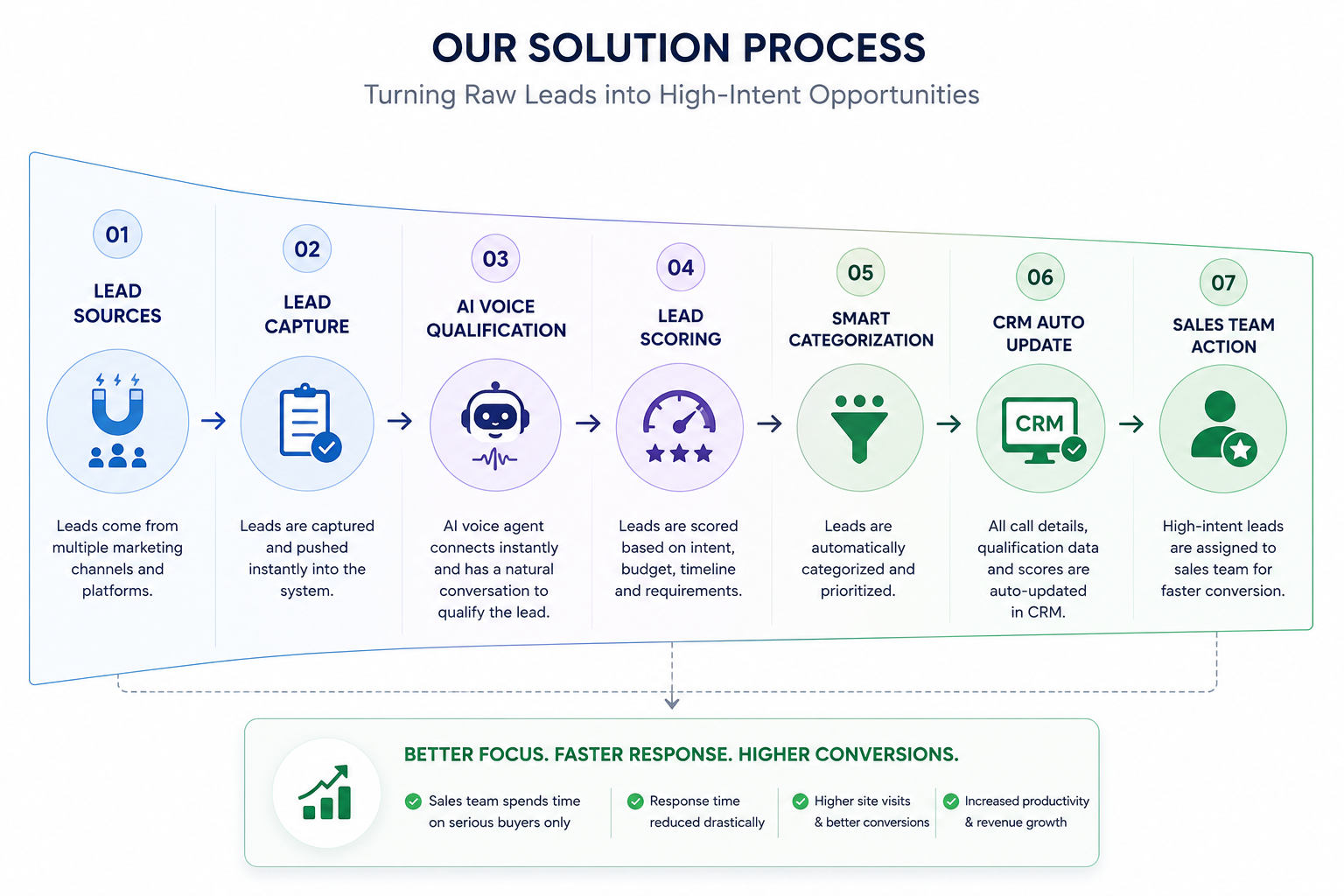
Here's the workflow Plexus designed and implemented
The AI voice agent contacts every new lead within seconds of inquiry capture. With instant engagement and no manual intervention, prospects are connected before they can lose interest or explore competitors.
Every lead is asked the same key questions - budget, timeline, and requirements. Ensuring consistent qualification and reliable data collection without manual effort.
The system automatically scores and categorizes every lead, helping sales teams focus on the most promising opportunities first.
Qualification data, lead scores, and call summaries are automatically synced to the CRM in real time, ensuring accurate and up-to-date records without manual entry.
Only qualified leads reach the sales team, along with the insights needed for effective follow up. Sales teams can focus on serious buyers instead of filtering inquiries manually.
What Changed with the AI Qualification System
| Category | Before Plexus | After plexus |
|---|---|---|
| Lead Response Time | Manual calls, often 6 - 15 hours after inquiry | AI voice agent responds within seconds, every time |
| Qualification Process | Inconsistent - different results every time | Standardised across every lead, every source |
| CRM Accuracy | Updated when executives remembered | Auto updated after every AI interaction, in real time |
| Sales Team Time | Majority spent dialling and filtering | Focused entirely on scored, high-intent leads |
| High Intent Buyers | Waited in the same queue as casual browsers | Identified, prioritised, and routed immediately |
| Revenue Conversations | A small fraction of total daily sales activity | The primary activity, not the exception |
Key Takeaways
The real challenge wasn’t the volume of leads; it was the lack of an intelligence layer that bridges lead capture and the sales team.
Responding in under 5 minutes boosts your chances of qualifying a lead by 21 times, but manual processes can make that tough to manage on a larger scale.
When it comes to CRM accuracy, it’s not just about discipline; it’s about how we design our processes. We need to take the human element out of the update loop.
Establishing standardized qualification criteria across all lead sources is crucial for ensuring predictable conversions.
BAaaS emphasizes the importance of diagnosing the workflow before recommending a solution - the right fix follows the right analysis.
Your team should close deals, Not chase leads.
Frequently asked questions
Does AI lead qualification work for smaller real estate teams or only large developers?
Absolutely! It’s especially beneficial for mid sized developers, Those who are getting a steady stream of inquiries but don’t have enough team members to handle them all quickly. If your team is juggling over 50 – 60 inquiries a month and still making calls to every lead manually, you’re likely missing out on conversions due to workflow inefficiencies
Will customers mind speaking to an AI agent first?
Not at all! The qualification call is crafted to feel like a friendly first response, Quickly gathering essential intent information in a professional manner. Most buyers actually prefer a speedy reply. What really turns them off is waiting around for 6 hours to hear back. In this case, speed is far more important than who makes that initial call.
What happens to the CRM data after AI qualification?
Every interaction, like qualification answers, lead scores, and call summaries, gets automatically sent to the CRM without any manual effort. When the sales team logs in, they’ll find detailed, up to date records ready for them.
How long does it take to implement a system like this?
Plexus doesn’t build the AI voice agent from scratch – it deploys a proven qualification platform with custom scoring logic, question flow, and CRM routing rules designed around your lead sources and sales process. No custom development means faster go-live and immediate ROI. Most real estate sales teams are live and receiving pre qualified leads automatically within 2 – 3 weeks of workflow mapping completion.
What if a lead doesn't engage with the AI voice agent?
Leads that don’t respond are flagged and scored appropriately, then placed in a follow up sequence. This way, they’re not forgotten, just given a lower priority. The sales team can circle back to them later at a reduced cost, while keeping their main focus on high-intent buyers.
How does AI lead qualification improve real estate developer efficiency?
AI analyzes CRM data, website activity, buyer preferences, and inquiry timing to identify the best leads. It also considers market trends and project data to improve accuracy. Strong privacy controls and continuous learning help keep predictions reliable and compliant.
How does AI lead qualification affect project timelines and approvals?
AI helps developers identify serious buyers faster, reducing delays and speeding up sales conversations. Better data and insights also support planning, approvals, and financing decisions, helping projects move forward more efficiently.