Why is Responsible AI becoming essential for businesses?
Artificial intelligence is no longer limited to experimentation. Businesses now use AI to automate workflows, support customers, analyze documents, generate reports, and improve decision-making. As adoption grows, many organizations are realizing that governance is not keeping pace.
61% of surveyed CEOs express concerns regarding the data sources used in generative AI. While adoption increases operational efficiency, these leaders are addressing significant legal, compliance, and operational risks. IBM Institute for Business Value.
This is why Responsible AI has become a business priority rather than simply a technical discussion.
Responsible AI helps organizations ensure that AI systems remain transparent, reliable, secure, compliant, and aligned with business objectives throughout their lifecycle. Instead of asking, “How can we deploy more AI?”
Businesses should first ask, “Can we trust the AI systems we already use?”
What is Responsible AI, and why does it matter for businesses?
Many people associate Responsible AI only with ethics. In reality, it is about building trust, reducing risk, and creating accountability across every stage of an AI system.
Responsible AI ensures that AI systems produce reliable outcomes, operate transparently, protect sensitive information, and support business decisions responsibly.
Healthcare provides a good example. Researchers found that some AI models produced different outcomes across patient groups because the training data lacked adequate representation. The technology itself wasn’t the problem. The issue was insufficient governance around data quality, testing, monitoring, and validation. World Health Organization – Ethics & Governance of Artificial Intelligence for Health
The same challenge exists across industries.
Whether AI approves a loan, screens job candidates, evaluates insurance claims, detects fraud, or recommends financial actions, organizations should always be able to answer four critical questions.
Why did AI make this decision?
AI decisions should have clear and traceable reasoning.
Can the decision be explained?
Business users, regulators, and customers should understand how important decisions are made.
Is the outcome fair?
AI should minimize bias and produce consistent outcomes across different users and situations.
Who is accountable if something goes wrong?
Every AI system should have a clearly defined business owner responsible for oversight and decision-making.
Answering these questions before deploying AI helps organizations reduce compliance risks, strengthen customer trust, and build AI systems that can scale responsibly.
Where do businesses face the biggest AI governance risks?
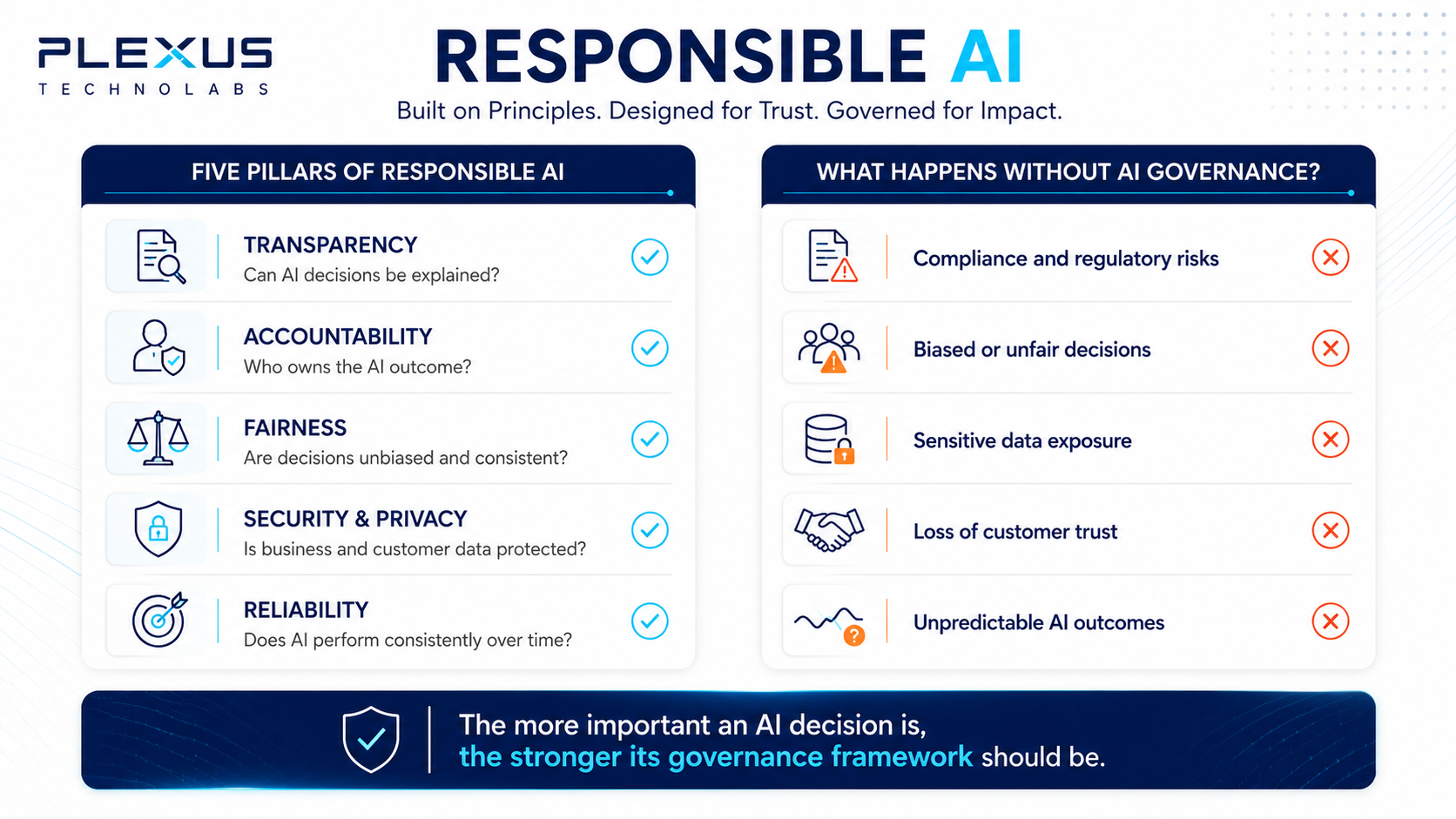
The biggest AI risks arise when automated systems influence decisions that affect people, finances, compliance, or business reputation. While AI improves efficiency, it can also introduce bias, reduce transparency, and create regulatory challenges without proper governance.
AI is now used to screen job applicants, approve loans, detect fraud, process insurance claims, and support healthcare decisions. These use cases deliver significant value, but they also require strong governance because their outcomes directly affect individuals and organizations.
A well known example involved Amazon, which discontinued an AI recruiting tool after discovering it had learned biased hiring patterns from historical hiring data. The lesson was clear: AI can recognize patterns, but it cannot determine whether those patterns are fair or appropriate. Reuters – Amazon AI Recruiting Tool
As AI adoption grows, organizations must be able to explain important AI-driven decisions, especially in regulated industries. Accuracy alone is no longer enough – businesses also need transparency, accountability, and compliance throughout the AI lifecycle. NIST AI Risk Management Framework
How do organizations implement Responsible AI in practice?
Responsible AI starts long before an AI model goes live. Leading organizations establish governance, assign accountability, and monitor AI systems throughout their lifecycle rather than treating compliance as a one time activity.
A practical Responsible AI framework includes:
> Evaluating training data for quality and completeness.
> Testing AI models for bias and fairness.
> Assigning ownership for every AI system.
> Establishing human review for high impact decisions.
> Monitoring AI performance after deployment.
> Documenting key decisions and model changes.
> Reviewing compliance requirements before implementation.
Together, these practices help organizations reduce risk, strengthen trust, and scale AI responsibly. Responsible AI is not just a technical framework – it’s an ongoing business governance process. NIST AI Risk Management Framework, OECD AI Principles, ISO/IEC 42001
How can you assess your organization's AI governance readiness?
Before expanding AI initiatives, evaluate whether these governance practices are already in place.
- AI generated outputs are reviewed before critical business decisions.
- Business teams can explain how important AI driven decisions are made.
- Every AI system has a clearly defined owner.
- Sensitive business and customer data is protected throughout the AI lifecycle.
- AI systems are continuously monitored after deployment.
If some of these areas need improvement, you’re not alone. Many organizations adopt AI faster than they build governance processes. Identifying these gaps early helps reduce compliance, operational, and reputational risks before they become costly problems.
To access our complete Responsible AI Readiness Checklist and AI Governance Assessment Framework, contact Plexus. Our team evaluates your governance maturity, identifies compliance gaps, and provides a practical roadmap for implementing trustworthy AI aligned with your business objectives.
Get a clear understanding of your AI governance maturity and discover where your organization should focus next.
Frequently asked questions
How does the Plexus Responsible AI Assessment help my organization?
Our assessment evaluates your AI governance maturity, existing AI initiatives, business processes, and compliance requirements. We identify governance gaps, prioritize improvement opportunities, and deliver a practical roadmap for implementing trustworthy AI aligned with your business goals.
How do I know if my organization is ready to scale AI?
Organizations are typically ready when they have defined business processes, quality data, governance controls, and clear accountability for AI systems. Plexus assesses these areas to determine your AI readiness and identifies what needs to be strengthened before scaling AI initiatives.
We already use AI across our business. Can Plexus still help?
Yes. Many organizations adopt AI tools before establishing governance. Plexus reviews your existing AI systems, evaluates governance maturity, identifies compliance risks, and recommends improvements that strengthen trust, transparency, and long-term scalability.
How do you identify AI governance and compliance gaps?
We review your AI lifecycle from a business perspective, including governance policies, ownership, data management, risk controls, monitoring processes, and regulatory requirements. This helps us identify gaps before they become operational or compliance issues.
What do we receive after the Responsible AI Assessment?
You’ll receive an AI governance maturity assessment, identified compliance and operational risks, prioritized recommendations, and a practical roadmap for strengthening governance and scaling AI responsibly across your organization.